


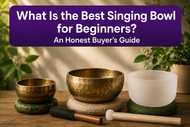
What Is the Best Singing Bowl for Beginners? An Honest Buyer's Guide
Posted by Jeff Howard on 26th May 2026
Most people who buy their first singing bowl ask the same question in the first five minutes of browsing: which one is the right one for me? And the honest answer, the one most articles will not give you, is that there is no single best beginner bowl. There are smart starting points. There are choices that make the learning curve gentle. There are also pitfalls that turn a beautiful instrument into a $300 paperweight on a shelf.
This guide is the one I wish someone had handed me. We sell hundreds of bowls to first-timers every year and we have watched what works, what gets returned, and what people grow into. By the end of this you will know exactly what to look for, what to skip, and why the research actually points to first-time practitioners feeling the most benefit of all.
The Surprising Truth: Beginners Feel It More
Before you spend a dollar, here is something worth knowing. The most cited peer reviewed study on singing bowl meditation, published by Goldsby and colleagues at the University of California San Diego in 2017, followed 62 participants through a single sound meditation session. After the session, participants reported significant reductions in tension, anger, fatigue, and depressed mood, with all results at p < .001.¹
Here is the part that matters for you. The researchers found that participants who had never experienced singing bowl meditation before showed a significantly greater reduction in tension compared to people who had done it many times before. Read that again. New practitioners benefited more, not less.
The takeaway is not that experienced practitioners get nothing from their bowls. It is that you are about to feel something genuinely new in your nervous system, and there is real science behind why. You do not need the most expensive bowl in the shop to access that. A well-made, well-tuned beginner bowl will get you most of the way there.
What Actually Matters When You Pick Your First Bowl
Forget the marketing for a minute. After fielding thousands of "I am brand new, what should I buy" emails, the criteria that actually predict whether someone falls in love with their first bowl come down to five things.
1. Sound that pulls you in immediately. If you do not feel something in the first five seconds of hearing a bowl, that is not the bowl for you. Your nervous system already knows. Trust it.
2. A size you can actually hold and play. Big bowls look impressive in product photos and feel impossible on a couch. More on size below.
3. Easy to play, not finicky. Some bowls require very specific mallet pressure and angle to sing well. Beginner bowls should be forgiving.
4. A reasonable price for a real instrument. The $20 Amazon "bowl" is not a singing bowl. It is a soup bowl with marketing. Walk past it.
5. Room to grow. The right beginner bowl is one you will still reach for two years from now, not one you will outgrow in two months.
The Four Best Singing Bowls for Beginners (Real Recommendations)
Here is where I stop hedging and actually pick. These are the four categories I steer first-time buyers toward, in roughly the order most people end up choosing.
1. Frosted Crystal Singing Bowls (Best All-Around Beginner Choice)
If you cornered me at a party and asked what to buy, this is what I would say. A frosted crystal singing bowl in the 8 to 10 inch range is the single most forgiving, accessible, easy-to-love first bowl on the market.
Three reasons. First, the sound is pure and sustained. One strike and the tone holds for thirty seconds, sometimes longer, which means you do not need any technique to enjoy it. Second, the matte frosted finish is easier to grip than clear quartz, which matters when your hand is still figuring out the rim-playing motion. Third, the durability is real. Frosted bowls are thicker than clear ones and forgive a lot of clumsy handling while you learn.
The vibrations from crystal bowls operate in a higher frequency range than metal bowls, and while most of the peer reviewed research has been done on Himalayan bowls specifically (we will get to those next), the underlying mechanism is the same. Research on vibroacoustic therapy has shown that sustained sound vibration can stimulate parasympathetic activity, the "rest and digest" branch of the nervous system that switches off the stress response.²
Best for: meditation, sleep, chakra work, anyone who responds to clean sustained tones.
2. Mid-Size Hand-Hammered Himalayan Singing Bowls (Best for the Traditional Sound)
If you came to singing bowls because of yoga classes, sound baths, or that one trip to Nepal, you are probably picturing a Himalayan bowl. Bronze, hand-hammered, full of overtones that swirl in the air like smoke. The sound is more complex than crystal, and for a lot of people it is also more emotionally moving.
The sweet spot for beginners is a 5 to 7 inch hand-hammered Himalayan bowl. Big enough to deliver the layered overtones that make these bowls famous, small enough to hold steady on the flat of your palm while you learn to play the rim, light enough to travel with.
Real talk on what to avoid here. Skip antique Himalayan bowls as a first purchase. They are extraordinary instruments, but they are unforgiving, and the variation in quality is huge. New hand-hammered bowls from reputable importers are far more consistent. Save the antique hunt for bowl number three or four.
Best for: traditional meditation practice, layered ambient sound, yoga and sound healing classes, anyone drawn to the original Himalayan tradition.
3. Aluminum Singing Bowls (Best Budget Option)
If price is the deciding factor, aluminum singing bowls are the honest answer. Light, bright, affordable, and durable enough to throw in a bag and bring to a friend's house. They are not a replacement for a quality Himalayan or crystal bowl, but they are not pretending to be.
What you give up: the deep low overtones of a heavier bronze bowl, and some of the visual gravitas. What you get: a real, playable instrument at a fraction of the price, perfect for beginners who want to test the waters before committing to a more expensive bowl.
Best for: gifts, travel, kids and classrooms, anyone on a tighter budget who still wants something real.
4. Zen Therapeutic Series Bowls (Best for Practitioners-in-Training)
A more specific recommendation, but worth mentioning. If you are buying your first bowl because you want to do something with it on people (sound healing sessions for a partner, eventually working with clients, body placement work), the Zen Therapeutic series is worth a serious look. The ZT900 in particular is sized and weighted specifically for body placement and rim playing, with a tone profile designed for healing work rather than concert performance.
These cost more than a standard beginner Himalayan bowl, but they are an investment-grade tool. Buy this once, use it for fifteen years.
Best for: aspiring sound healers, bodyworkers, anyone planning to use the bowl on or near another person's body.
What Size Singing Bowl Should a Beginner Buy?
Size is the single most under-thought decision in a first bowl purchase. People see a 14 inch bowl in a sound healer's Instagram and assume bigger is better. It is not. Bigger is louder, deeper, and much harder to play well.
For most beginners, the sweet spot is:
- Crystal bowls: 8 to 10 inches. Big enough to sing easily with rim play, small enough to handle one-handed while seated.
- Himalayan bowls: 5 to 7 inches. Easy to balance on your palm. Travels well. Loud enough to fill a normal room without overwhelming it.
- Aluminum bowls: 7 to 9 inches. These run small naturally. Stick with the higher end of that range for better tone.
A general principle worth remembering. Smaller bowls produce higher tones, larger bowls produce lower tones. Lower tones tend to feel more grounding in the body, but they are also harder for a beginner to coax out of a bowl. Start in the middle, learn the technique, then size up later if you want more depth.
What to Skip as a Beginner
Just as important as what to buy is what to walk past. Here is the short list.
Skip the cheap Amazon bowls. A real singing bowl, even at the entry level, costs more than $50. Anything below that is almost certainly a decorative bowl with a striker, not a tuned instrument. The sound dies in two seconds and there are no real overtones. You will give up on singing bowls entirely if this is your first experience.
Skip seven-bowl chakra sets at the start. They look like an incredible value, and for some people they are. But buying seven bowls at once means you spread your budget thin across seven mediocre bowls instead of one excellent bowl. Better path: buy one well-made bowl that you love. Add to the set later if you genuinely want to.
Skip antiques. Mentioned above, worth repeating. Antique Himalayan bowls are wonderful for collectors. They are a terrible first bowl. Inconsistent quality, harder to play, expensive to make a mistake on.
Skip clear quartz crystal as your absolute first bowl. Clear quartz is gorgeous. It is also more slippery in the hand than frosted, and the high pure tone is less forgiving of technique mistakes. Buy clear quartz as your second crystal bowl, once you know what you are doing.
What Else You Need (And What You Can Wait On)
A bowl by itself is incomplete. Here is what actually needs to come home with you and what can wait.
Buy now: a quality mallet (or two). Almost every bowl comes with a starter mallet, and almost every starter mallet is decent but not great. The mallet determines half of how your bowl sounds. A leather-wrapped suede mallet in the right size for your bowl is one of the single best upgrades you can make to a beginner setup. If you only buy one accessory with your bowl, make it this.
Buy now: a cushion or ring. Singing bowls need to rest on something soft to ring properly. A small fabric ring or cushion costs almost nothing and prevents the bowl from contacting hard surfaces that dampen the tone. Many bowls ship with one. If yours does not, add it.
Wait on: a carrying case. Useful if you travel with your bowl. Skip it if your bowl will live on a shelf or altar at home.
Wait on: a tuning fork. Tuning forks are wonderful complementary tools for advanced practice. They are not a beginner essential.
Wait on: a second bowl. Resist this for at least three months. Get to know your first bowl deeply. The relationship you build with one bowl is more valuable than scattering your attention across three.
How to Play Your First Bowl (The Two-Minute Version)
A proper how-to-play guide deserves its own article, but here is the absolute minimum you need to know on day one.
The strike. Hold the mallet like a pencil. Tap the side of the bowl, not the rim, with the padded end. Light contact. You are inviting the bowl to sing, not hitting it.
The rim play. Once the bowl is humming from the strike, slowly run the mallet around the outside of the rim, holding it at about a 45 degree angle, with light steady pressure. The bowl will start to build a sustained tone. Keep the speed even. The single most common mistake is going too fast.
Listen. Stop, breathe, and actually listen for thirty seconds after the bowl stops ringing. The space after the tone is part of the practice. This is where the nervous system actually shifts.
That is enough to start. Everything else is refinement.
Common Beginner Mistakes (And How to Avoid Them)
A few patterns we see again and again from first-time owners.
Hitting too hard. Singing bowls do not need force. Heavy strikes make them rattle and clang instead of sing. If your bowl sounds harsh, you are playing too hard.
Wrong mallet for the bowl. A small mallet on a big bowl will not bring out the low overtones. A big mallet on a small bowl will overwhelm it. Match mallet size to bowl size.
Playing on the wrong surface. A bowl resting directly on a hard table will choke its own tone. Always play on a cushion, ring, or your palm.
Expecting drama every time. Some sessions feel transcendent. Some feel like you just rang a metal bowl in your living room. Both are normal. Show up consistently and the deeper experiences will come.
Comparing your bowl to YouTube videos. Studio recordings of bowls use microphones, reverb, and editing. Your bowl in your kitchen will not sound like that. It is not supposed to. It will sound like your bowl in your kitchen, which is its own kind of magic.
Beginner FAQ
Are crystal or Himalayan singing bowls better for beginners? Both work. Crystal bowls are slightly easier to play and sustain longer tones. Himalayan bowls have more complex layered sound. Pick based on which sound moves you more when you listen to samples. For more on crystal vs. Himalayan singing bowls, see my post on Crystal Singing Bowls vs Himalayan Singing Bowls: Which One Is Right for You?
Do I have to know my chakras to use a singing bowl? No. The science behind singing bowls works on the nervous system regardless of whether you engage with chakra concepts. If chakra work is part of your practice, great. If not, the bowl still works.
How much should I spend on my first bowl? A solid beginner bowl from a reputable seller typically runs $80 to $250. Spending less almost always means lower quality. Spending more is fine if the bowl genuinely sings to you, but it is not required.
Can I use a singing bowl every day? Yes. Daily use is one of the best ways to develop a relationship with your bowl and a meditation practice around it. Even five minutes a day adds up.
Do singing bowls actually work, or is it pseudoscience? The honest answer is somewhere in the middle. The strongest research (Goldsby 2017, plus more recent systematic reviews) shows real, measurable reductions in tension, anxiety, and depressed mood after singing bowl meditation, and improvements in heart rate variability.¹ ³ The exotic claims (curing diseases, balancing energy fields) have not been demonstrated in peer reviewed research. Use the bowls for what they are proven to do: support relaxation, focus, and stress reduction. That alone is worth the investment.
Where should I keep my singing bowl? Somewhere accessible. The single biggest predictor of whether someone actually uses their bowl is whether they can see it from the couch. Bowls in closets gather dust. Bowls on coffee tables get played.
The Bottom Line
The best singing bowl for beginners is the one you will actually play. Sound quality matters. Size matters. Material matters. But the bowl on your shelf that calls to you when you walk past is the bowl that will change something in your life. The one in the box in the attic will not.
If you want a single answer to "what should I buy first," here it is: an 8 to 10 inch frosted crystal bowl, or a 5 to 7 inch hand-hammered Himalayan bowl. Either one, with a quality mallet and a cushion, will start you on a practice that the research suggests will have real, measurable effects on how your body holds stress.
And keep the Goldsby finding in your back pocket. As a first-time practitioner, you are statistically the most likely person in the room to feel the difference. That is a remarkable place to start.
Related Reading
For a deeper dive into the different types of bowls available, see our complete guide on the types of singing bowls. For a direct head-to-head comparison, see crystal vs Himalayan singing bowls. Once you have your bowl, our companion guide on how to play a singing bowl walks through technique in detail.
References
- Goldsby, T. L., Goldsby, M. E., McWalters, M., & Mills, P. J. (2017). Effects of Singing Bowl Sound Meditation on Mood, Tension, and Well-being: An Observational Study. Journal of Evidence-Based Complementary & Alternative Medicine, 22(3), 401-406. https://pubmed.ncbi.nlm.nih.gov/27694559/
- Skille, O., Wigram, T., & Weekes, L. (1989). Vibroacoustic Therapy: The Therapeutic Effect of Low Frequency Sound on Specific Physical Disorders and Disabilities. Journal of British Music Therapy, 3(2), 6-10. https://journals.sagepub.com/doi/10.1177/135945758900300202
- Stanhope, J., & Weinstein, P. (2025). Therapeutic effects of singing bowls: A systematic review of clinical studies. Advances in Integrative Medicine. https://www.sciencedirect.com/science/article/pii/S2213422025000241