


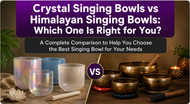
Crystal Singing Bowls vs Himalayan Singing Bowls: Which One Is Right for You?
Posted by Jeff Howard on 7th Jun 2026
You've felt it before. That deep, humming wave that rolls through a yoga class or sound bath and seems to settle right behind your ribs. Singing bowls do that to people. The trouble starts when you decide to buy one, because almost immediately you hit the same question everyone hits: crystal or Himalayan?
They look different. They sound different. They come from completely different worlds. And the answer to "which is better" is not what most people expect, so let's get into it.
A Quick Word on Himalayan Singing Bowls
Himalayan singing bowls (sometimes still called Tibetan bowls in older shops) have been around for centuries across Nepal, Tibet, India, and Bhutan. The traditional ones are forged from a metal alloy, often a blend of seven metals meant to represent celestial bodies, with copper and tin doing most of the heavy lifting in the recipe.
You play them in one of two ways. Strike the rim with a padded mallet for a single ringing note, or run a wooden striker around the outside edge to coax out a sustained, slightly wobbly tone that feels almost alive.
They're known for warm, earthy overtones, a grounding quality that hits low in the body, deep cultural roots in Buddhist and shamanic practice, and the fact that they're small enough to travel with.
Browse our full collection of Himalayan Singing Bowls
A Quick Word on Crystal Singing Bowls
Crystal bowls are the newcomers. They only emerged in the 1980s, and the origin story is genuinely strange: they started life as crucibles used to grow silicon in the semiconductor industry. Someone tapped one, heard the tone, and a whole new category of instrument was born.
Modern crystal bowls are made from 99.99% pure quartz, with either a frosted or clear finish. Many are tuned to specific musical notes that line up with the seven chakras, which makes them popular for energy work.
They're known for pure, single frequency tones, an unusually long sustain, a bright and almost otherworldly quality, and serious visual presence. They're showpieces as much as instruments.
Browse our full collection of Crystal Singing Bowls
A quick aside before we get into the comparison. Crystal and Himalayan are the two big categories, but they aren't the only options out there. Antique bowls, Japanese rin gongs, cast bowls, and others each have their own character. If you want the full lineup before you commit to one type, take a look at our complete guide to the types of singing bowls. Otherwise, keep reading.
What Does the Research Actually Say?
Before we get into the head to head, it's worth pausing here. A lot of the claims floating around online about singing bowls are unverified, but a growing body of peer reviewed research does back up some real benefits. Here's what's actually been studied.
A 2017 observational study published in the Journal of Evidence-Based Complementary & Alternative Medicine followed 62 participants through a singing bowl sound meditation. Compared to baseline, participants reported significantly less tension, anger, fatigue, and depressed mood after the session, with all results at p < .001. Spiritual well being also increased significantly.¹
A 2025 systematic review in Healthcare looked at 14 quantitative studies on Himalayan singing bowl interventions across 16 years of research. The review found most studies reported significant reductions in anxiety and depressive symptoms, increases in heart rate variability (a marker of healthy autonomic nervous system function), and decreases in resting heart rate. Some studies also documented increased Delta and Theta brainwave activity, the patterns associated with deep relaxation and sleep.²
A 2025 study presented at the IEEE Engineering in Medicine & Biology Conference measured heart rate variability during a 30 minute Himalayan singing bowl meditation. Participants showed statistically significant improvements in autonomic balance and parasympathetic activity, the "rest and digest" branch of the nervous system that switches off the stress response.³
Researchers attribute much of this to two combined mechanisms. The first is the meditative state the sound encourages. A 2021 meta-analysis in Health Psychology Review covering dozens of randomized controlled trials found that meditation interventions produced statistically significant reductions in cortisol, the body's primary stress hormone, especially in people already dealing with elevated stress.⁴
The second is vibration itself. Research on vibroacoustic therapy has shown that low frequency sound vibrations in the 30 to 120 Hz range, the range Himalayan bowls operate in, can stimulate mechanoreceptors in the body (specifically the Pacinian corpuscles in the skin), trigger parasympathetic activation, and reduce muscle tension and pain perception.⁵
Quick honest note: most of the peer reviewed research to date has been conducted on Himalayan bowls specifically, not crystal bowls. Crystal bowls produce sound in a higher frequency range and the research on them is much thinner, mostly anecdotal or focused on general sound meditation rather than the bowls themselves. Anyone telling you otherwise is overselling.
The Real Differences
Sound
This is where the two part ways most dramatically.
A Himalayan bowl gives you complexity. One strike releases several overtones at once, layered and a little unpredictable, like the bowl is breathing. It's warm. It's textured. It feels old.
A crystal bowl gives you purity. One clean tone, often held for what feels like impossibly long, slicing cleanly through a room. People often describe it as celestial, which is a word I usually distrust, except in this case it really does fit.
Love rich and textured? Himalayan. Love clean and sustained? Crystal.
Use in Sound Healing
Both end up on healers' tables, but for different reasons.
Crystal bowls are the go-to for chakra work because they can be tuned to specific notes (C for the root, D for the sacral, and so on up the body). Their pure frequencies are easy to feel vibrating in particular places.
Himalayan bowls tend to win out for grounding, stress relief, and meditation. Practitioners also place them directly on the body during what's sometimes called vibrational massage, because metal carries vibration into tissue beautifully. You can't really do that with a crystal bowl without making everyone in the room nervous. A 2022 study in Medicina on the neurophysiological effects of singing bowl massage found measurable changes in subjective relaxation and physiological markers after direct body application.⁶
Price
Himalayan bowls cover a huge range. A small, machine made starter bowl might cost between $30 and $80. An authentic, hand hammered bowl from Nepal can run anywhere from $300 to well over $1,000, especially if it has age on it.
Crystal bowls run pricier on average. A solid 8 to 10 inch frosted quartz bowl usually starts around $150 to $300, and the bigger or rarer alchemy bowls can stretch past $2,000 without much trouble.
Durability
Himalayan bowls win.
A metal bowl will survive a backpack, a road trip, a curious toddler, and a fall onto a rug. A crystal bowl is essentially glass. It chips, it cracks, and if you really mess up, it shatters. Most owners keep theirs in padded cases and treat them with the kind of caution usually reserved for vintage cameras.
Browse our full collection of protective sleeves and cases.
How Hard They Are to Play
Himalayan bowls take some practice. Getting that smooth, singing tone by running the mallet around the rim is a feel thing. Wrong angle or wrong pressure and you'll get a chatter instead of a hum.
Crystal bowls are more forgiving. A gentle strike or a slow circle around the rim almost always produces a clean note. If you want results on day one, crystal is the easier place to start.
Look and Feel
Himalayan bowls feel ancient and handmade. Many are etched with mantras or symbols, and you can usually see the hammer marks if you tilt them in the light. They have lineage.
Crystal bowls feel modern, almost futuristic. They glow under colored lights, photograph beautifully, and tend to be the visual centerpiece of any space they're in.
Tradition
If a connection to spiritual lineage matters to you, Himalayan bowls have centuries of documented use in Buddhist and shamanic practice behind them. Just be aware that a lot of bowls sold as "antique Tibetan" online are nothing of the sort. The truly old ones are rare and expensive. Most affordable Himalayan bowls today are made in workshops in Nepal or India, which is fine, just know what you're buying.
Crystal bowls don't have any ancient tradition. Some people find that freeing. Others find it lacking. Your call.
So Which Is Better?
Neither. They're different instruments for different purposes, and the honest answer is that serious practitioners often end up owning both.
Go with a Himalayan singing bowl if you want warm complex sound, something portable and durable, a connection to traditional practice, an instrument you can use for body based sound therapy, or a more affordable entry point.
Go with a crystal singing bowl if you want pure sustained tones, an instrument tuned to a specific chakra or musical note, something visually striking, sound that fills a large room for group sessions, and you're willing to invest more and handle it carefully.
How to Pick Your First Bowl
A few honest tips before you spend money.
Listen before you buy whenever possible. Visit a shop. Play several. The right bowl is the one whose tone you actually feel, not the one with the nicest description online.
For a first bowl, go mid sized. Around 5 to 7 inches for Himalayan, 8 to 10 inches for crystal. Big enough to fill a room, small enough to live with.
Buy from sellers with real reputations. Avoid suspiciously cheap "antique" listings. If it's $40 and claims to be a hundred years old, it isn't.
Don't skimp on the mallet. The striker matters almost as much as the bowl itself, and a bad one will make a great bowl sound mediocre.
Check out our crystal bowl accessories or our Himalayan bowl accessories
Think about your space. Crystal bowls are loud and resonant. Glorious in an open room. Overwhelming in a one bedroom apartment with thin walls.
And one last thing. If neither crystal nor Himalayan feels quite right by the time you get to the end of this, you have more options than most people realize. Antique singing bowls, Japanese rin gongs, cast bowls, and Zen series bowls all live in their own niche. Our complete guide to types of singing bowls walks through all of them honestly, so you can figure out which family of bowl actually matches what you're looking for.
Final Thought
Crystal and Himalayan singing bowls aren't really competitors. They're cousins. One is rooted in centuries of tradition and feels like the earth. The other is a modern invention and feels like the sky.
Whichever one makes you exhale the moment you hear it is the right one. Don't overthink it.
References
- Goldsby, T. L., Goldsby, M. E., McWalters, M., & Mills, P. J. (2017). Effects of Singing Bowl Sound Meditation on Mood, Tension, and Well-being: An Observational Study. Journal of Evidence-Based Complementary & Alternative Medicine, 22(3), 401-406. https://pubmed.ncbi.nlm.nih.gov/27694559/
- Lin, F. W., Yang, Y. H., & Wang, J. Y. (2025). Effects of Tibetan Singing Bowl Intervention on Psychological and Physiological Health in Adults: A Systematic Review. Healthcare, 13(16), 2002. https://pmc.ncbi.nlm.nih.gov/articles/PMC12385955/
- The Effect of Tibetan Singing Bowls on Stress Reduction: A Heart Rate Variability Study. (2025). IEEE Engineering in Medicine & Biology Society Conference Proceedings. https://pubmed.ncbi.nlm.nih.gov/41335654/
- Koncz, A., Demetrovics, Z., & Takacs, Z. K. (2021). Meditation interventions efficiently reduce cortisol levels of at-risk samples: a meta-analysis. Health Psychology Review, 15(1), 56-84. https://www.tandfonline.com/doi/full/10.1080/17437199.2020.1760727
- Skille, O., Wigram, T., & Weekes, L. (1989). Vibroacoustic Therapy: The Therapeutic Effect of Low Frequency Sound on Specific Physical Disorders and Disabilities. Journal of British Music Therapy, 3(2), 6-10. https://journals.sagepub.com/doi/10.1177/135945758900300202
- Walter, N., & Hinterberger, T. (2022). Neurophysiological Effects of a Singing Bowl Massage. Medicina, 58(5), 594. (Referenced in singing bowl research literature)