


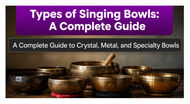
Types of Singing Bowls: A Complete Guide
Posted by Jeff Howard on 12th May 2026
Shopping for a singing bowl can get confusing fast. What you're actually looking at is a whole family of instruments, with traditions running from Himalayan villages where the same families have been hammering bronze for generations, to American crystal foundries that didn't exist before the 1980s.
A frosted crystal bowl and a hand-hammered Himalayan bowl are about as similar as a violin and a cello. They share a basic idea (a vessel that sings when you play it) and not much else. Different sound. Different history. Different reasons to own one.
This guide walks through every type of bowl we carry. Six crystal varieties, five traditional metal styles, plus our specialty Zen line. By the end you'll know what's out there, what they sound like, and which one probably belongs in your space.
The Two Great Families of Singing Bowls
Before we get to specific types, it helps to know that almost every singing bowl falls into one of two lineages.
Crystal singing bowls are the newer tradition. They were invented in the 1980s as an accidental side effect of semiconductor manufacturing. Quartz crucibles used to grow silicon ingots turned out to ring with extraordinary clarity when someone played them with a mallet. Within a decade, a whole new sound healing tradition had been born around them. Crystal bowls produce pure, sustained, single-frequency tones that fill rooms.
Metal singing bowls are the ancient tradition. Bronze bowls with musical properties have been made across the Himalayan region (Nepal, northern India, and the broader area sometimes called Tibet) for at least 2,500 years. The underlying bronze metallurgy goes back over 5,000 years to ancient Mesopotamia. Metal bowls produce complex, layered tones with multiple overtones playing at once. They feel grounding and embodied in a way crystal bowls don't.
Neither tradition is better than the other. They do different things. Crystal bowls open and lift; metal bowls anchor and root. A lot of serious practitioners end up owning both.
With that out of the way, here's what we sell.
Crystal Singing Bowls
Every crystal singing bowl starts with the same raw material: pure quartz crystal, which is just silicon dioxide, the most abundant mineral on Earth. The quartz gets crushed, melted at temperatures between 2,000 and 3,000°F, and shaped into bowl form. From there, different finishing processes, wall thicknesses, and design choices produce the varieties below.
Most crystal bowls are tuned to single, sustained notes (C, C#, D, D#, E, F, F#, G, G#, A, A# or B), which is why they're so popular for chakra work and for ensemble playing where multiple bowls need to harmonize. The trade-off is that they're more fragile than metal bowls. They need careful handling, especially when you're moving them around.
Frosted Crystal Singing Bowls
Frosted crystal bowls are the bowls most people picture when they hear "crystal singing bowl." They have an opaque, milky-white look with a slightly textured, sandblasted exterior. The walls are thick, usually around half an inch, which gives them substantial weight and remarkable acoustic power.
If you've ever sat through a sound bath and felt the sound literally vibrating in your chest, you were probably hearing a frosted bowl. A well-played frosted bowl can fill a large yoga studio off a single strike.
Their thickness also makes them the most beginner-friendly crystal bowl. They start singing quickly when you play around the rim, they forgive imperfect technique, and they're sturdier than thinner crystal varieties. (Still quartz, still breakable, still treat them carefully.)
Best for: Beginners learning crystal bowl technique. Sound bath facilitators. Yoga teachers. Group meditation leaders. Anyone who wants maximum volume and presence from a single bowl.
Clear Quartz Crystal Singing Bowls
Clear quartz bowls are made through a different process than frosted bowls. Rather than being formed in a mold, each clear quartz bowl is hand-blown from an even purer quartz combination. The result is visually stunning. These bowls look like sculpted glass, often with faint internal striations from the hand-blowing process.
Acoustically, clear quartz bowls behave differently than frosted bowls. Because of their wall heights and thickness, they typically produce lower frequencies and hold a noticeably longer sustain. Practitioners often describe the tone as purer or more focused. They're less about room-filling power and more about precision and depth.
Clear bowls are a touch more fragile than frosted ones because the polished surface shows every chip and scratch. They tend to cost more too, since the hand-blowing process is more labor-intensive and uses a higher-grade quartz.
Best for: Practitioners who care about visual beauty as much as sound. Smaller, more intimate sessions. People who are drawn to longer sustains and the focused, lower tones of clear quartz over the broader sound of frosted.
Empyrean Crystal Singing Bowls
Empyrean bowls share the white opacity and substantial wall thickness of frosted bowls, but with a refined, smoother finish that sits somewhere between the textured surface of frosted and the high polish of clear quartz. They're often described as an elevated version of the classic frosted bowl.
Acoustically, they deliver the same volume and sustain as frosted bowls, but a lot of practitioners hear them as cleaner. Less mallet friction noise, fewer harmonics competing for attention, a more singular tone. For sound healing work where clarity matters more than complexity, Empyrean bowls are usually the better pick.
Empyrean bowls are great starter bowls for those who want a cleaner sound compared to its frosted bowl counterpart.
Best for: Established practitioners moving up from a frosted bowl. Sound healers working with intentional frequency selection. Buyers who want the power of frosted with a more refined look and sound.
Featherlight Crystal Singing Bowls
Featherlight bowls are what the name sounds like. Crystal bowls made with thinner walls, cutting the weight dramatically. A standard Empyrean bowl can weigh five pounds or more. A Featherlight of the same diameter can weigh half that.
The trade-off is acoustic. Thinner walls mean less volume, less sustain, and a more delicate tonal character. Featherlights don't fill rooms the way frosted or Empyrean bowls do. They're more intimate, more conversational, often brighter and higher-pitched because thinner walls vibrate faster.
The huge advantage is portability. For practitioners who travel (mobile sound healers, yoga teachers visiting different studios, retreat leaders), a Featherlight is a lot easier on your back and a lot less stressful to ship.
Best for: Traveling practitioners. Intimate one-on-one sessions. Smaller home practice spaces. Anyone who's struggled with the weight of standard crystal bowls.
Practitioner Crystal Halo Handle Singing Bowls
Halo handle bowls are crystal bowls with a built-in handle, designed to be held in the hand rather than placed on the floor or a table. The one piece handle bowl is blown from a tube of quartz during manufacturing, so it's structurally part of the instrument rather than an attachment.
These bowls are made for hands-on work. Sound healers moving a bowl over a client's body. Energy workers directing sound to specific chakras or body regions. Practitioners who want to physically guide the vibration rather than let it radiate from a fixed point. Because they're played in the air rather than on a cushion, halo bowls have a quality of directionality that fixed bowls don't. You can aim the sound.
They're usually smaller and lighter than floor-played bowls, both for practical handling and to stay comfortable across a long session. A lot of practitioners build up a small collection of halo bowls in different notes to use over different body areas during a single treatment.
Best for: Sound healers. Energy workers. Reiki practitioners. Massage therapists. Anyone offering hands-on bodywork who wants to bring sound into their sessions.
Gemini Crystal Singing Bowls
Gemini crystal bowls are a specialty within the crystal family. They're less common than the standard types above and tend to get picked up by experienced practitioners looking for a specific sonic or visual quality not found in standard frosted, clear, or Empyrean bowls.
Our Gemini bowls are made using a similar process to our Halo handle practitioner bowls, but with an important difference: each Gemini is crafted to produce two distinct tones from a single bowl. This dual-tone capability gives practitioners significantly more range without needing to carry or switch between multiple bowls. They're an excellent choice for practitioners who move around the room during sessions, since one bowl can deliver two different notes on demand. They're also a favorite among sound healers working with binaural beats, where two close frequencies are used together to create a specific entrainment effect.
Best for: Experienced collectors and practitioners looking for a specialty bowl with unique sonic qualities beyond the standard crystal line. Particularly well-suited for mobile practitioners and those working with binaural or dual-tone techniques.
Metal Singing Bowls
Metal singing bowls are older than the crystal family by thousands of years. They're made from bronze alloys, typically copper and tin in roughly 80/20 proportions, sometimes with trace amounts of other metals. They're either hand-hammered or cast in molds. Each method produces a different sound.
Unlike crystal bowls, which mostly hold a single pitch, metal bowls produce a fundamental note plus two or three audible overtones. This is what gives them their famously layered, shimmering sound. Multiple frequencies playing at once and beating against each other.
Himalayan Singing Bowls
The Himalayan singing bowl is the classic. It's the bowl most people mean when they say "Tibetan singing bowl," even though the vast majority of these bowls actually come from Nepal and northern India, with materials originally sourced from across the broader Himalayan region. (We get into the full story of that in our upcoming article on the origins of Himalayan singing bowls.)
These bowls are hand-hammered by artisans, often in multi-generational family workshops. A single bowl can take days to make. The bronze is heated, hammered, reheated, and hammered again, gradually taking shape through what's called the annealing process. Slight variations in wall thickness from the hammering produce the rich harmonic overtones that make these bowls so musically complex.
Himalayan bowls vary enormously in size, weight, and tone. A small one might weigh under a pound and sing in the upper octaves. A large one can weigh ten pounds or more and produce deep, low fundamental notes that you feel in your bones. Most people playing for personal meditation end up with bowls in the 6 to 8 inch range, which offer a good balance of portability and presence.
Best for: Daily personal meditation. Grounding practice. Anyone drawn to traditional craftsmanship. Practitioners who want a portable bowl with rich harmonic depth.
Antique Singing Bowls
Antique singing bowls are genuinely old. Most are between 50 and 200 years old, occasionally older. They're prized for two reasons. First, their craftsmanship, which often reflects techniques and care no longer found in modern production. Second, their sound, which a lot of practitioners say is distinctly different from anything new bowls can produce.
The reason aged bowls sound different has to do with the bronze itself. Over decades of use, the metal's crystalline structure shifts and becomes more brittle, which paradoxically improves the resonance. The bowl sings more freely and with more sustained overtones. Antiques often carry visible signs of their history. Patina, wear from generations of mallets, sometimes small chips or marks. These aren't defects. They're provenance.
Antiques are also a lot more expensive than new bowls. Partly because of rarity, partly because they're effectively non-renewable. No new antiques are being made.
Best for: Serious practitioners ready to invest in a bowl they'll keep for life. Collectors who care about craftsmanship and history. Anyone who feels specifically called to the sound of aged metal.
Japanese Rin Gongs
Rin (鈴) is the Japanese word for bell, and rin gongs are the singing bowls of the Japanese tradition. You'll find them in nearly every Japanese Buddhist temple, used to mark the start and end of meditation periods, accompany chanting, and structure ceremonial rituals. A lot of Japanese households also keep a rin on their family altar.
Rin gongs are hammered from very high-quality bronze, often with more attention to musical pitch than Himalayan bowls. The sound is famously clean. Bright, bell-like, with a long sustain and a more defined harmonic profile than Himalayan bowls.
Stylistically, rin gongs often look different from Himalayan bowls. More uniform in shape, often with simpler exteriors, sometimes with a polished finish that reflects the Japanese aesthetic preference for clean lines.
Best for: Zen practitioners. Anyone drawn to Japanese Buddhist tradition. Practitioners who value tonal precision. People who want a bell-like clarity over the rougher harmonics of Himalayan bowls.
Aluminum Singing Bowls
Aluminum singing bowls are the modern outsider in the metal family. Instead of traditional bronze, they're made from aluminum alloys. Much lighter, far more affordable, and notably bright in tone.
They aren't a replacement for traditional bronze bowls and don't try to be. The sound is different. Clearer and more piercing, with fewer harmonic overtones but more sustain in the fundamental note. Some practitioners love this clarity. Others find it too thin compared to bronze. It's a real preference question, not a quality issue.
The practical advantages are significant. Aluminum doesn't oxidize the way bronze does, so it needs less maintenance. It's much lighter, which makes it portable. And it's substantially less expensive, which makes it a smart entry point for someone curious about metal bowls who isn't ready to invest in a traditional Himalayan one.
Best for: Budget-conscious beginners. Outdoor use. Low-maintenance practice. Practitioners who specifically prefer brighter tones over deep bronze overtones.
Cast Singing Bowls
Cast bowls are made by pouring molten bronze into a mold rather than hand-hammering it into shape. You end up with a bowl with much more uniform wall thickness, more consistent shape, and a more predictable tone.
This consistency cuts both ways. Cast bowls don't have the slight irregularities that produce the complex, alive sound of hand-hammered Himalayan bowls. They're acoustically simpler. Fewer overtones, more direct fundamental notes. But that simplicity is exactly what some practitioners want. If you're building a set of bowls that need to harmonize precisely (for chakra work, say), cast bowls are easier to match because their tones are reliable.
Cast bowls also tend to cost less than hand-hammered Himalayan bowls. The manufacturing process is faster, and individual bowls require less artisan time.
Best for: Practitioners building tuned ensembles. Sound healers who need consistent pitch across a collection. Beginners who want a metal bowl without the higher price of hand-hammered work.
Zen Singing Bowls: Our Therapeutic Line
Zen singing bowls are our high-end therapeutic line. Bowls selected and crafted specifically for use in clinical, therapy, and serious wellness contexts where consistency, durability, and sonic quality all need to operate at a premium level.
What sets our Zen bowls apart is the additional refinement they receive after the initial hand-hammering process. Every bowl in this line goes through a secondary treatment — typically lathing — that smooths the surface into a seamless finish and removes the small inconsistencies that can muddy the tone of a standard hand-hammered bowl. The result is a more sonically pure soundscape: cleaner fundamentals, more even harmonics, and a sustain that carries without the rough edges or competing overtones you sometimes hear in less-refined bowls.
That purity is what makes the Zen line especially well-suited for on-the-body work, where the bowl rests directly on the recipient and the vibration is felt as much as heard. It's also why these bowls are a favorite for personal meditative practice, where subtle tonal variations matter and consistency from session to session is part of the experience.
Best for: Professional therapists. Clinicians offering sound-based wellness services. Practitioners who do on-the-body work. Anyone with an established personal meditation practice ready to invest in their highest-quality instrument.
Does Any of This Actually Work?
Worth a quick aside, because we get this question a lot.
Sound healing research is still young, but it's grown a lot in the last decade. A 2017 observational study published in the Journal of Evidence-Based Complementary & Alternative Medicine found that Tibetan singing bowl meditation produced measurable reductions in tension, anger, fatigue, and depressed mood across 62 participants. A more recent 2025 systematic review covering multiple Tibetan singing bowl studies found consistent improvements in anxiety, depression, heart rate variability, and brainwave activity.
We share this not to oversell. Plenty of the bigger claims around sound healing are not well supported by science. But the basic idea, that resonant sound combined with intentional stillness can shift the nervous system into a more relaxed state, has reasonable evidence behind it. That's most of what people who own singing bowls are actually using them for.
How to Choose: A Quick Decision Framework
Twelve different bowl types is a lot. Here's a shortcut.
If you're brand new to singing bowls, start with either a medium frosted crystal bowl (8 to 10 inches, often tuned to F for the heart chakra) or a medium hand-hammered Himalayan bowl (6 to 8 inches). Both are forgiving for beginners and have enough sonic richness to teach you what you actually like.
If you facilitate sound baths, frosted or Empyrean crystal bowls are your workhorses. Their volume fills rooms and their sustain gives you room to breathe between strikes. A lot of facilitators eventually build out a full chakra set of crystal bowls.
If you do hands-on bodywork, Practitioner Crystal Halo Handle bowls or Zen Therapeutic bowls are made for that. Start with one in a note that resonates for you and build from there.
If you travel often, Featherlight crystal bowls or smaller Himalayan bowls are the most portable. A Himalayan bowl in the 5 to 7 inch range packs well and is basically unbreakable in transit.
If you're drawn to tradition, Himalayan singing bowls (especially hand-hammered ones) connect you to 2,500 years of continuous craft tradition. If budget allows, antique bowls take that connection further.
If you're working in a clinical or professional therapy context, our Zen therapeutic line is built specifically for that use case.
If you're budget-conscious, aluminum or cast bowls give you a real metal singing bowl experience at a fraction of the price of hand-hammered work.
Listen to recordings whenever you can before buying. The right bowl is almost always the one whose sound, when you hear it, makes something in you go still.
One Last Thing
There's no hierarchy among singing bowl types. A four-hundred-dollar antique Himalayan bowl isn't "better" than a hundred-dollar aluminum bowl. They're different instruments for different paths.
Whichever direction you lean, take your time. Read. Listen. Visit if you can. The relationship between you and your bowl will, in a lot of cases, last for decades. Sometimes generations. It's worth choosing well.
If you have questions about any specific bowl type or want help narrowing things down, we're always happy to talk it through. Reach out anytime. Sound is personal, and the right guidance makes a real difference.