


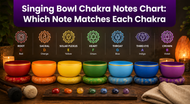
Singing Bowl Chakra Notes Chart: Which Note Matches Each Chakra
Posted by Jeff Howard on 1st Jul 2026
If you have shopped for singing bowls for more than about five minutes, you have run into the chart. Root chakra is C. Crown chakra is B. Seven chakras, seven notes, one tidy rainbow running up the spine. It shows up on product pages, in Pinterest graphics, taped to the wall of half the yoga studios in the country.
Here is the thing almost nobody selling bowls will tell you: that chart is a convention, not a law of nature. It is useful. It is also mostly a modern Western invention with a thin coat of ancient-sounding varnish. Both of those things can be true at once, and you can still love your bowls and use the chart to pick one.
So let's do the honest version. Below is the chakra notes chart you came for, plus where it actually came from, where frequency claims hold up and where they fall apart, and the five myths that cause the most confusion. Then, yes, we will talk about our seven bowl chakra sets, because they are built around exactly this chart and they nest together in a way that is a little bit magic.
The chakra notes chart, at a glance
Here is the standard Western mapping, root to crown, the one you see everywhere:
| Chakra | Sanskrit Name | Note | Color | Location |
|---|---|---|---|---|
| Root | Muladhara | C | Red | Base of the spine |
| Sacral | Svadhisthana | D | Orange | Below the navel |
| Solar Plexus | Manipura | E | Yellow | Upper abdomen |
| Heart | Anahata | F | Green | Center of the chest |
| Throat | Vishuddha | G | Blue | Base of the throat |
| Third Eye | Ajna | A | Indigo | Center of the brow |
| Crown | Sahasrara | B | Violet | Top of the head |
That's it. That's the whole chart. Take the C major scale, lay it against the body from bottom to top, and assign one note per center. Clean and easy to remember, which is a big part of why it caught on.
Want the printable version? We made a clean, downloadable chart you can save, pin, or print for your practice space.

You'll see the popular Solfeggio frequencies on our chart above because that's the common convention, but see Myth 2 for why we treat them as symbolic rather than scientific.
A quick honesty note before we go further. This is one common system, not the only one. Some sound practitioners start the root at F. Some use the pentatonic scale. Plenty of teachers argue there is no fixed note for any chakra at all, and that your body's own "root note" depends on your voice and size. Keep that in your back pocket. It matters later.
Where the seven chakras actually came from
The word chakra is Sanskrit for wheel or disk. The idea of energy centers along the spine is genuinely old, but the neat seven-part system most of us picture is younger and messier than the marketing suggests.
The earliest hints show up in later Upanishads, which reference nadis (subtle channels) and prana (life energy) moving through the body. From roughly the 6th through the 16th centuries, various Tantric traditions developed these ideas, and different schools used different numbers of centers. Four. Five. Six. Sometimes twenty-one. There was no single agreed-upon map.
The seven-chakra model we know got its most influential write-up in a Sanskrit text called the Sat-Cakra-Nirupana, composed by Purnananda in the 16th century (it forms one chapter of a larger work). That text describes six centers along the spine plus the thousand-petaled lotus above the crown. It is dense, symbolic, and deeply tied to meditation practice, not to music theory.
The West met all of this fairly late. In 1919, a British scholar named Sir John Woodroffe (writing as Arthur Avalon) translated the Sat-Cakra-Nirupana in a book called The Serpent Power. That book is basically the on-ramp for the entire Western chakra conversation. A few years later, Theosophist writers, most notably C. W. Leadbeater in his 1927 book The Chakras, layered on the rainbow color scheme largely from their own visions and interpretations.
Sit with that timeline for a second. The rainbow colors so many charts treat as ancient scripture are less than a hundred years old, and they came from a Western esotericist, not from the original Sanskrit sources. Those older texts describe different hues entirely.
So why the C major scale? (The part with no real history)
Here is where the trail goes cold, and I want to be straight about that.
Nobody in the Sat-Cakra-Nirupana was tuning bowls to C. The pairing of the seven chakras with the seven notes of the C major scale is a modern Western overlay, and as far as anyone can document, it exists for one simple reason: it's convenient. Western music has a seven-note diatonic scale. The popular chakra model has seven centers. Two sevens, lined up bottom to top, lower notes for lower centers. Done.
It is a mnemonic dressed up as a metaphysical truth. That does not make it worthless. A shared vocabulary is genuinely helpful when you're trying to build a set of bowls that feel like they belong together, or when a teacher wants students on the same page. But it is not handed down from a mountain, and it is not measured in a lab. It is a matching exercise that stuck because it's tidy.
You can see the seams if you look. Change the key and the whole chart slides. Ask three sound healers and you may get three different starting notes. The system only feels fixed because it gets repeated so often, in so many identical charts, that it starts to look like consensus.
How chakras and frequencies relate, and where they don't
Let's separate two claims that constantly get blended together.
Claim one: sound and vibration can affect how you feel. This one has real support. A long, resonant tone from a well-made bowl can slow your breathing, quiet mental chatter, and nudge you toward a calmer state. That is measurable, and we'll get to the studies.
Claim two: a specific frequency in Hertz maps to a specific chakra, and playing it "tunes" or "heals" that center. This one has no scientific basis. None. There is no measured resonant frequency of the heart chakra the way there is a resonant frequency of a wine glass. Chakras are not physical organs you can point to on an MRI. They are a contemplative model of the body, and models like that don't come with Hertz values attached.
The honest middle ground is this: the sound can move you. The number attached to it is symbolic. When a bowl labeled "F, heart chakra" helps you feel open and settled, that is a real experience, and it is happening because of the sound, the intention, and the quiet you have given yourself, not because 349 Hz unlocked a spinning wheel of energy in your chest. You lose nothing by enjoying the practice. You only get into trouble when someone sells the number as medicine.
Five chakra and frequency myths worth clearing up
Myth 1: Each chakra has one fixed, scientifically proven frequency
This is the big one, and almost everything else grows out of it. You will see charts listing exact Hertz values for each chakra as if they were pulled from a physics textbook. They weren't. Different charts list different numbers, and they contradict each other constantly, which is a dead giveaway. If root chakra were truly 396 Hz on one chart and 194 Hz on another and a C note on a third, they can't all be the fundamental truth of the universe. They are conventions competing for attention. Pick the one that helps your practice and hold it loosely.
Myth 2: The Solfeggio frequencies are ancient, and 528 Hz repairs your DNA
The "ancient Solfeggio frequencies" (396, 417, 528, 639, 741, 852 Hz, and later a few more) feel old. They are not. The specific frequencies were popularized in the 1990s by Joseph Puleo and Leonard Horowitz, most prominently in Horowitz's 1999 book. Puleo said he arrived at the numbers through a numerology exercise on the Book of Numbers in the Bible, partly by intuition and vision. That is the actual origin story. Not a monastery. A numerology puzzle in the late twentieth century.
The medieval solfège system (do, re, mi, and so on) is real, and it traces to Guido of Arezzo and a hymn to John the Baptist. But that was a teaching tool for singing pitches, with no fixed frequencies at all, because standardized scales didn't exist yet. As for 528 Hz repairing DNA, there is no credible scientific evidence for that claim. It's a lovely story. It's marketing.
Myth 3: 432 Hz is the "natural" tuning and 440 Hz was a conspiracy
You have probably seen this. The idea that A should be tuned to 432 Hz because it's the frequency of the universe, or water, or your cells, and that 440 Hz was imposed by some sinister plot (the Nazi version is a popular flavor). Fact-checkers and acoustics researchers have gone through this thoroughly, and it does not hold up. Modern concert pitch (A = 440 Hz) is just an international standard agreed on for consistency. There is no measured "frequency of the universe" that 432 happens to hit, and no documented conspiracy behind 440.
When researchers have actually compared 432 Hz and 440 Hz music head to head under controlled conditions, the differences were small and inconsistent. One double-blind pilot study found no strong evidence that 432 is healthier. If a 432 recording sounds nicer to your ear, wonderful, enjoy it. Just don't mistake preference for physics.
Myth 4: The rainbow-and-note system is thousands of years old
We covered the history above, so this one is short. The rainbow color coding is roughly a century old and came from Western Theosophists. The note mapping is younger still and has no traditional source at all. When a chart implies this whole color-and-tone framework was practiced by ancient yogis, it is borrowing authority it hasn't earned. The underlying chakra concept is old. The pretty modern chart is not.
Myth 5: Playing the "right" note fixes the matching organ or emotion
This is where honest wellness content has to draw a line. You'll see claims that a G bowl treats thyroid problems, or a C bowl cures anxiety, or that toning the correct note clears a "blocked" chakra and resolves the physical illness attached to it. Those are not supported claims, and treating them as medical advice can be genuinely harmful if it delays real care. Sound practices can absolutely help you relax, and relaxation is good for you. But a singing bowl is not a prescription, and no note on any chart replaces a doctor.
Why do these myths spread? Mostly because they scratch a real itch. People do feel something when they sit with these sounds, and a precise-looking number gives that feeling a story and a structure. The intuition (sound affects us) is sound. The specific claims stapled onto it usually are not.
A seven bowl set built around the chart
Now the fun part, and the reason a lot of people land on this page in the first place.
If you want to actually work with the full chakra notes chart instead of just reading about it, you need one bowl per note, root to crown, tuned to sit together as a set. That is exactly what our two chakra sets are for.
The Zen Pro Chakra Colored Brass Himalayan Singing Bowl Sets are seven tuned brass bowls, each finished in the color of its chakra, running C through B. It is the chart made physical: you can literally see the rainbow and hear the scale climb from the grounded low C of the root up to the bright B of the crown.
If your taste runs more traditional, the Etched Chakra Brass Himalayan Singing Bowl Sets give you the same seven tuned notes with hand-etched chakra symbols on each bowl instead of color. Same idea, quieter aesthetic. Both are genuine metal Himalayan bowls, not decorative pieces, so each one holds its note and sustains the way a real bowl should.
Check out our Zen Pro 7 Bowl Chakra Brass Himalayan Singing Bowl Sets
One thing people don't expect: these sets nest. Because the bowls are graduated in size along the scale, they stack down into one another and pack into a surprisingly small footprint, which is great if you travel with them or just don't have a shelf to spare. The trick is nesting them in the right order so they seat snugly instead of getting stuck inside of each other or rattling around. We made a short video walking through what comes with our Himalayan Singing Bowl Sets as well as how to properly unpackage and store them.
To be clear, and in keeping with everything above: buying a seven note set won't "align your chakras" in some clinical sense. What it gives you is a complete, coherent instrument for a sound practice you'll actually enjoy and return to. That's the honest pitch, and it's a good one.
How to actually use a chakra notes chart
You made it through the myth-busting, so here's the payoff: how to use the chart in a way that's both enjoyable and honest.
Treat it as a menu, not a diagnosis. If you're drawn to grounding and steadiness, reach for the low notes (C and D). If you want something bright and airy for the end of a session, the high notes (A and B) do that beautifully. This isn't because those notes are medically matched to those centers. It's because low, slow tones feel settling and high tones feel opening, and the chart is a friendly way to organize that instinct.
Pick by ear first. The single best way to choose a bowl is to hear it. A note that resonates with you, in the plain everyday sense of the word, will do more for your practice than the "correct" note on any chart. If you're building toward a full set, that's where a tuned seven-bowl collection earns its keep: you get the whole scale, and you can follow the chart when you want structure or ignore it when you want to just play.
And if a teacher or seller tells you a specific frequency will cure a specific ailment, that's your cue to be skeptical. Enjoy the sound. Keep your doctor.
Frequently asked questions
What note is each chakra?
In the common Western system: root C, sacral D, solar plexus E, heart F, throat G, third eye A, crown B. It follows the C major scale from the base of the spine to the top of the head. Just remember it's a modern convention, not an ancient or scientific standard.
Which singing bowl note is best for the root chakra?
The chart assigns C to the root chakra. In practice, any lower, deeper-toned bowl tends to feel grounding, which is the quality people associate with the root. Choose the one whose tone feels settling to you.
Are chakra frequencies scientifically real?
No. There's no measured resonant frequency for any chakra, and chakras aren't physical structures you can scan. Sound can genuinely help you relax, which is supported by research, but the specific chakra-frequency pairings are symbolic conventions, not measured facts.
Do I need all seven bowls?
Not to start. Many people begin with a single bowl they love. A full seven-note set is worth it once you want to play the whole scale or work through the chakras in sequence, and tuned sets like ours are built so the notes belong together.
Is 432 Hz better than 440 Hz for chakra work?
There's no reliable evidence that 432 Hz is healthier or more "natural." The idea is modern folklore. Use whichever sounds better to you.
What the research actually shows
Here is what solid, peer-reviewed work does support, stated plainly and without inflation.
Singing bowl sound meditation appears to help people relax and feel better in the moment. In an observational study of 62 adults, participants reported significantly less tension, anger, fatigue, and depressed mood after a sound meditation session using metal bowls and other instruments, along with a rise in feelings of spiritual well-being (Goldsby et al., 2017). A 2023 randomized controlled trial found that a single session of Himalayan bowl sound treatment produced an acute relaxation response, measurable in self-reported anxiety and heart rate variability, comparable to progressive muscle relaxation (Rio-Alamos et al., 2023). An EEG study of a bowl sound massage recorded shifts in brain activity consistent with a more meditative, relaxed state (Walter & Hinterberger, 2022).
Now the caveats, because they are the honest part. A 2020 systematic review looked at the whole field and concluded that while results point in a positive direction, the number of quality studies is small and the methods have limitations, so we can't make strong clinical recommendations yet (Stanhope & Weinstein, 2020). Translation: the relaxation effect is promising and reasonably supported. The specific chakra-and-frequency claims are not part of what these studies tested or found.
Notice what none of this research does. It does not validate the note-to-chakra chart. It does not measure a frequency for any chakra. It does not show that a particular note heals a particular body part. It supports the general practice of sitting with these sounds as a relaxation tool, which, frankly, is plenty.
Sources
Goldsby, T. L., Goldsby, M. E., McWalters, M., & Mills, P. J. (2017). Effects of Singing Bowl Sound Meditation on Mood, Tension, and Well-being: An Observational Study. Journal of Evidence-Based Complementary & Alternative Medicine, 22(3), 401-406. https://pmc.ncbi.nlm.nih.gov/articles/PMC5871151/
Rio-Alamos, C., Montefusco-Siegmund, R., Cañete, T., Sotomayor, J., & Fernandez-Teruel, A. (2023). Acute Relaxation Response Induced by Tibetan Singing Bowl Sounds: A Randomized Controlled Trial. European Journal of Investigation in Health, Psychology and Education, 13(2), 317-330. https://pmc.ncbi.nlm.nih.gov/articles/PMC9955072/
Walter, N., & Hinterberger, T. (2022). Neurophysiological effects of a singing bowl massage. Medicina, 58(5), 594. https://www.mdpi.com/1648-9144/58/5/594
Stanhope, J., & Weinstein, P. (2020). The human health effects of singing bowls: A systematic review. Complementary Therapies in Medicine, 51, 102412. https://www.sciencedirect.com/science/article/abs/pii/S096522991931756X
On tuning claims: a double-blind cross-over pilot study comparing music at 440 Hz and 432 Hz found no strong evidence of superior health effects for either. Music tuned to 440 Hz versus 432 Hz and the health effects. EXPLORE, 15(4), 283-290 (2019). https://www.sciencedirect.com/science/article/abs/pii/S1550830718302763