



How to Play a Singing Bowl: The Magic Equation
Posted by Jeff Howard on 2nd Jun 2026
So you have a singing bowl in front of you. Maybe it is brand new, maybe it has been sitting on a shelf for years waiting for you to figure it out. Either way, you tap it, you drag a mallet around the rim, and you get... a clunk. A rattle. A sound that stops the second you lift the mallet. Not the warm, endless hum you were hoping for.
Don't worry. You are not doing anything wrong, and your bowl is not broken. Playing a singing bowl well is a skill, and like any skill it clicks once you understand the mechanics behind it. The good news is that there are really only three things to learn, and once you feel them in your hands, your bowl will sing every single time.
Let's get into it.
The Two Ways to Play Any Bowl
Before anything else, know that every singing bowl can be played two ways.
The first is striking (also called tapping). You hit the bowl once with a mallet and let it ring out. This gives you a clear, bell like tone that blooms and slowly fades. It is the easiest way to play and the one most people start with.
The second is rim singing. You press a mallet against the outside edge of the bowl and move it in a steady circle. Friction builds, the bowl starts to vibrate, and you get that sustained, swelling hum that singing bowls are famous for. This one takes practice, but it is absolutely learnable.
You can do both with the same bowl. You can even strike a bowl first to "wake it up" and then start rim singing. There is no single correct method, only the one that gives you the sound you want in the moment.
The Magic Equation
Here is the single most useful thing in this entire post. If you remember nothing else, remember this:
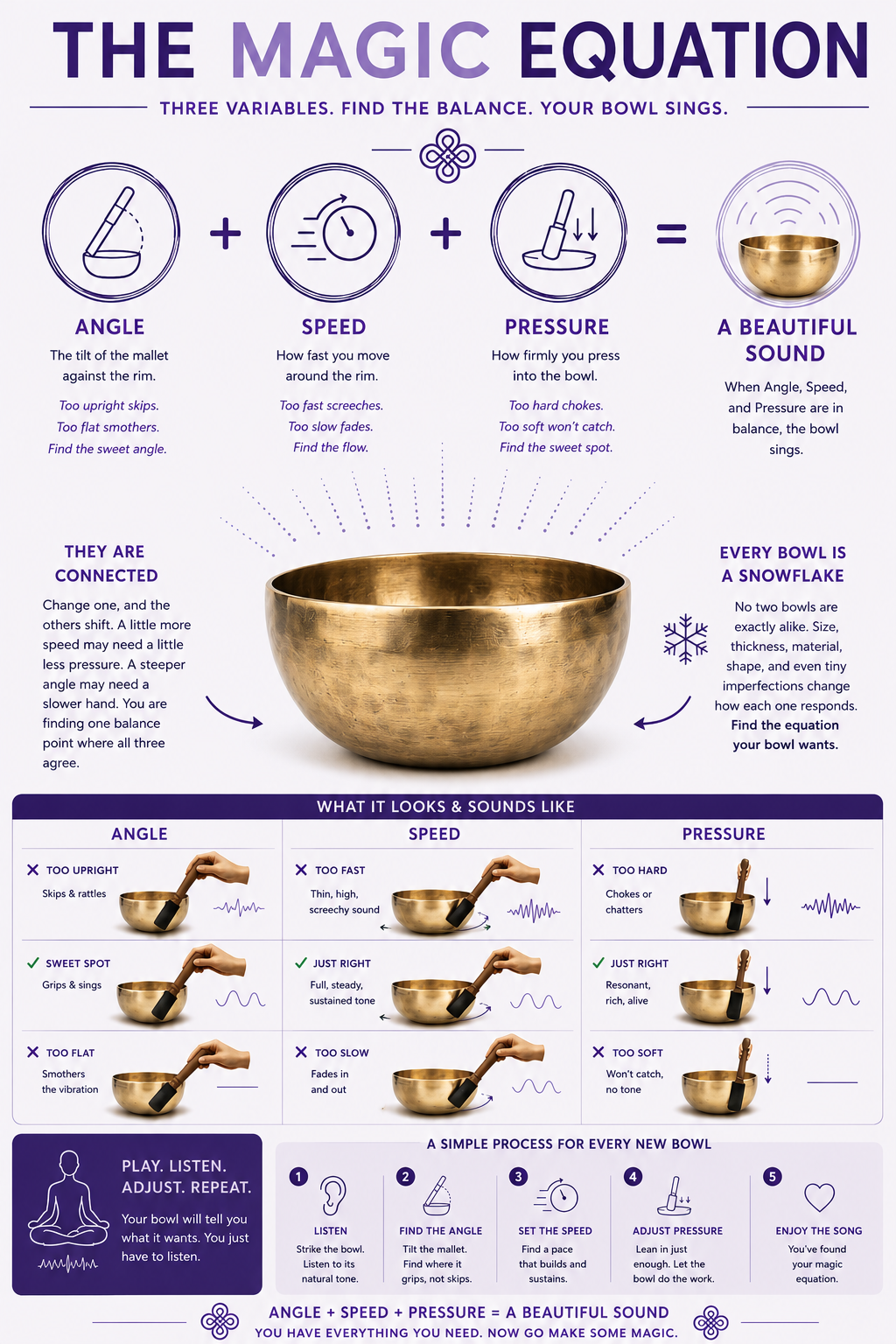
Angle + Speed + Pressure = a beautiful sounding bowl
That is the Magic Equation. Three variables. Get them balanced and your bowl sings. Get one of them off and the sound wobbles, rattles, squeaks, or dies.
Let's break down each one.
Angle is how you hold the mallet against the bowl. For rim singing, this means the tilt of the mallet as it travels around the edge. Too upright and you skip across the surface. Too flat and you smother the vibration. There is a sweet angle where the mallet grips the rim and pulls the tone out, and it is different for every bowl.
Speed is how fast you move the mallet around the rim (for singing) or how quickly you make contact (for striking). Move too fast and the tone never has time to build, so you get a thin, screechy sound. Move too slow and the vibration fades between passes. Somewhere in the middle the bowl locks into its note and holds it.
Pressure is how firmly you press the mallet into the bowl. Press too hard and you choke the vibration or get an ugly chatter. Press too softly and nothing catches. The right pressure feels almost like you are gently leaning the mallet into the rim and letting the bowl do the work.
Here is the part most beginners miss. These three are connected. Change one and you usually have to adjust the other two. A little more speed often wants a little less pressure. A steeper angle might need a slower hand. You are not solving three separate puzzles, you are finding one balance point where all three agree.
Every Bowl Is a Snowflake
Now for the truth that nobody tells you when you buy your first bowl.
There is no universal setting. The angle, speed, and pressure that make one bowl sing beautifully will make another bowl rattle and complain. Every single bowl is different.
I mean that literally. A bowl's size, wall thickness, material, shape, and even the tiny imperfections from how it was made all change how it responds. A small frosted crystal bowl wants a completely different touch than a heavy hand hammered metal bowl. A wide shallow bowl behaves nothing like a tall narrow one. Two bowls that look almost identical on a shelf can need noticeably different handling to sound their best.
Think of it like this. Each bowl is as unique as a snowflake. No two are exactly alike, and no two ask for exactly the same Angle, Speed, and Pressure.
This is the reason your friend's technique might not transfer to your bowl, and it is the reason a video can show you the idea but never hand you the exact numbers. You have to re tune the Magic Equation for each bowl you play. When you sit down with a new one, treat it like a short conversation. Try an angle. Adjust the speed. Ease off or lean into the pressure. Listen. Adjust again. Within a minute or two the bowl will tell you what it wants, and once it does, it will sing for you reliably.
So as you watch the demos below, do not try to copy the exact motion frame for frame. Watch what the player is adjusting and why, then go find your own balance point with your own bowl.
Watch It Done: Five Demonstrations
Reading about angle, speed, and pressure only gets you so far. Seeing and hearing it is what makes it click. Below are five short demonstrations covering the most common bowls and techniques. Watch how the player adjusts their touch for each one, and notice how different the same basic motion looks from bowl to bowl.
1. Frosted Crystal Bowl: Striking
Start here, because striking a frosted bowl is the most forgiving way to play. Frosted crystal has a slightly textured surface that catches the mallet nicely. Notice in the demo how light the strike is. You are not hitting it like a drum, you are letting the weight of the mallet do most of the work. Watch the angle of the strike too, glancing rather than dead on, which lets the tone bloom instead of clunking.
2. Frosted Crystal Bowl: Rim Singing
Same bowl, completely different technique. Here is where the Magic Equation really shows itself. Watch how the player keeps the mallet pressed firmly to the outside of the rim and moves at a slow, even, almost lazy pace at first. The tone does not appear instantly. It builds. As the bowl starts to hum, notice how they often slow down slightly and ease off the pressure to keep the sound smooth instead of letting it screech. That tiny adjustment is the equation in action.
3. Metal Bowl: Tapped with a Felt Mallet
Now we move to metal. A felt mallet on a metal bowl gives you a soft, round, mellow tone with very little of the metallic "ping" you might expect. This is a lovely gentle sound, great for meditation. Watch the angle in the demo, the player taps the side of the bowl rather than the very top edge, which brings out the warm fundamental note. Pressure is low and the contact is quick, a tap and release rather than a press.
4. Metal Bowl: Struck with a Suede Mallet
Same metal bowl, swap the felt for suede, and the whole character changes. A suede mallet gives a brighter, more present strike with more of the bowl's higher tones coming through. This is a great example of why the bowl is only half the story, the mallet shapes the sound just as much. Notice how the player might strike a little more firmly here than with the felt, because suede grips differently. Different mallet, different equation.
5. Metal Bowl: Rim Sung with a Suede Mallet
This is the technique that surprises people. Rim singing a metal bowl with a suede mallet produces that deep, swelling, otherworldly hum you hear in sound baths. It is also where angle and pressure matter most. Watch closely. The player holds the suede mallet at a fairly upright angle, presses it firmly into the outer rim, and moves at a steady, deliberate pace. If they go too fast the bowl squeals. Too slow and it stalls. When the angle, speed, and pressure all line up, the bowl locks into its note and holds it for as long as they keep moving. That locked in moment is exactly what you are chasing.
Troubleshooting: When the Bowl Won't Sing
Even with the equation in mind, you will hit snags. Here are the usual culprits and the fix, which almost always comes back to adjusting one of the three variables.
You hear a rattle or chatter instead of a tone. Your pressure is too high, your speed is wrong for that pressure, or your mallet keeps bouncing. Ease off the pressure first, then slow your hand down until the chatter smooths into a hum. You will tend to notice a rattle or "chatter" on thinner walled crystal bowls that need less pressure to get activated.
The bowl squeals or sounds harsh. You are going too fast. Slow down. A singing bowl rewards patience, not effort.
The sound dies the moment you slow down. Your pressure is too light, so the friction never sustains. Press a touch more firmly into the rim and keep your speed steady.
It just clunks when you strike it. Check your angle and your grip. Hold the mallet loosely, let it bounce off the bowl rather than pushing through it, and try striking the side rather than the very top of the rim. Also make sure the bowl is sitting on a cushion or ring and that your other hand is not muffling it.
It worked yesterday and not today. This is the snowflake principle again, often combined with a new mallet, a different surface under the bowl, or a different room. Re tune the equation. It only takes a few seconds once you know what you are listening for.
Remember: Angle + Speed + Pressure
A Few Habits That Help
Sit or stand somewhere quiet for your first sessions so you can actually hear the subtle changes as you adjust.
Hold the mallet loosely, like you are holding a pencil, not gripping a hammer. A death grip kills your control.
Keep your supporting hand flat and still under the bowl, or rest the bowl on an oring or cushion. Touching the side while it sings will deaden the tone fast.
Practice on one bowl until you can make it sing on demand, then move to a second bowl and feel how completely different the equation has to be. That contrast is the fastest way to truly understand why the Magic Equation matters.
And be patient with yourself. Almost nobody nails rim singing on the first try. Give it ten minutes and something will click.
Final Thought
Playing a singing bowl is not about strength or talent. It is about listening and adjusting. Angle, speed, pressure. Three small dials you turn until the bowl agrees with you. Learn to feel that balance and you can pick up almost any bowl, anywhere, and coax a beautiful tone out of it within a minute.
Just remember the snowflake. The bowl in your hands right now wants something slightly different from every other bowl on earth. Listen to what it asks for, give it that, and it will sing.
References
- Goldsby, T. L., Goldsby, M. E., McWalters, M., & Mills, P. J. (2017). Effects of Singing Bowl Sound Meditation on Mood, Tension, and Well-being: An Observational Study. Journal of Evidence-Based Complementary & Alternative Medicine, 22(3), 401-406. https://pubmed.ncbi.nlm.nih.gov/27694559/
- Lin, F. W., Yang, Y. H., & Wang, J. Y. (2025). Effects of Tibetan Singing Bowl Intervention on Psychological and Physiological Health in Adults: A Systematic Review. Healthcare, 13(16), 2002. https://pmc.ncbi.nlm.nih.gov/articles/PMC12385955/